We work with a lot of people asking “How can I get money?” or “How can I make more money?” The first thing we do is work with those people to make sure they are budgeting and spending wisely. If you are not doing those 2 things, then no amount of “more money” will be enough. That’s why many people who win the lottery end up broke after a while.
Once we have worked on the budgeting aspect, then we discuss ideas for generating more income. It is a good idea to find multiple sources of income so that you don’t have all your eggs in one basket. What’s more is that you may be able to find more passive sources of income so that you can devote your time to things that are important to you. And by this I mean income from rental properties or affiliate programs, something where you don’t have to be so involved but still generate some cash flow.
See this article on Generating Alternate Income to get a better understanding of why you should be considering alternate sources of income and some ideas on getting started. Here is a short list of ways you could be bringing in cash besides your primary occupation:
- Rental income/rental property
- Turn a hobby into a job (i.e. you love to craft, why not sell your items at craft fairs?)
- Freelance work writing, making phone calls, or giving advice in your area of expertise
- Delivering newspapers or phone books
- Pick up odd jobs like painting your company’s offices – a little extra cash here and there adds up, and you don’t have to work a busy schedule ALL the time, just occassionally
- Taking care of other children. You can do this if you already have kids so you can stay home and be with them while still making some money.
- Sell your stuff. Have a garage sale or list items on eBay and craigslist.
You can check out this article on alternate income for more details on some of the items above.
So remember, first get your finances straight as far as how you are budgeting and spending. Our Financial Training Courses help you do that (PLUS determine your spending personality, give you a new definition of money, help you set goals and leave a legacy for your family, and find balance in all the areas of your life so that your finances can thrive and you can honestly say “I LOVE my life!”).
Then find some ways to bring extra cash into your household. Find one, two, or even three things that bring money into your house effectively so that you are not working 100% of the time but can still enjoy your life and spend time with your family.
After you’ve taken those steps the question changes from “How can I get money?” to “How can I make my money work for me?” You’ll want to make sure you are putting your extra money into savings and investments so that your money will be able to grow. Then you’ll be on your way to reaching your financial dreams!

 Hello from all of us at iMoneyCoach. Today I’d like to share with you some ways to stop sabotaging your finances so that you can become successful with your money:
- First, you need to spend less than you earn. Find ways to cut costs, save money, and get out of debt. The more you put on your credit card or finance, the more you end up paying in the long run. And the deeper you go into debt, the longer it takes to get out.
- Next, be sure that you have an accumulation or periodic savings account. This is an account in addition to your regular savings account that you can use for those expenses that you know might come up, but you just don’t know when. For example, when your car breaks down and you need $500 to get it fixed. If you have that money set aside already, you will not have to dip into your savings or worry about how you can get the money together to get the repairs done. It will save you a lot of headache and stress.
- Be conscious of your budget and how your purchases affect it. If you know that you only have $100 left in your budget for entertainment this month, then it is not a good time to buy a $500 bicycle. When you have made a budget based on your priorities, you can be sure that you are spending on the things that are most important to you.
How do you start doing all these things? Learning how to be successful with your money can seem tough, maybe even impossible. But don’t worry – it IS possible! There are many workbooks and seminars out there that can help you figure out how to get out of debt and work a budget, but those often leave people lacking. That’s why we have developed a system that actually works.
At iMoneyCoach our goal is to teach you how to be successful with your finances in such a way that you will also be able to enjoy your life. Most financial plans out there are similar to diets. They may work for a short time, but you eventually end up back where you started. Instead, at iMoneyCoach we look at your individual needs and situation to determine what changes you need to make in order to have lasting success and happiness.
So stop sabotaging your finances. Sign up for the iMoneyCoach Financial Life Training System online courses to learn what you need to know to be successful with your money.
Tags: budget
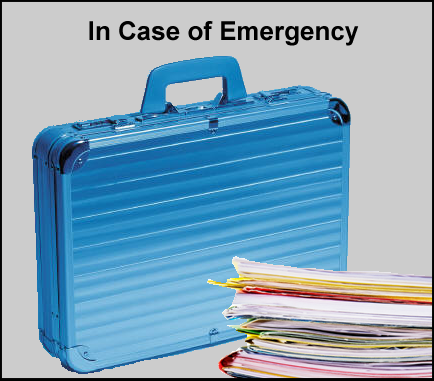 There are things in life we hope will never happen, but it can’t hurt to be prepared. In fact, it can give you peace of mind and save you stress in the event of an actual emergency. As you run out the door, you will thank yourself if you already know what to grab and don’t have to waste precious time trying to figure out what you need to take with you.
Today I’d like to share with you the idea of creating a Grab-N-Go box, something that has your important information in it that you can grab easily in case of a fire or evacuation so you don’t have to start from scratch. Just having some identification can make it easier to put your life back together.
The first thing to do is to go buy a small waterproof, fireproof container, preferably one you can lock since you will have valuable information inside. It is a good idea to get one that is not so heavy that you can’t carry it but big enough to fit the documents and valuables that you want to save.
Next, pick a place to store your Grab-N-Go box. You don’t want to leave it sitting out on a counter where a burglar would have prime access to all your important information, but it is also probably not a good idea to hide it behind a stack of boxes on the top shelf of your closet either. You need to be able to grab this box quickly in the event of an emergency. If it is a box that locks, be sure you have hidden the key somewhere nearby in a place you will remember. For example, if you store your box behind a pair of snow boots in the hall closet, maybe you have the key taped to the bottom of a shelf in the same closet. Be sure that your spouse or significant other knows where this box is too.
Finally, you will want to gather up documents to put in this Grab-N-Go box. Even if you have a waterproof container, it is a good idea to separate documents and files into plastic bags for extra protection just in case.
What you include is really up to you, but here is a list of things that would be a good idea to have. It may be a good idea to keep copies of these documents in a safe-deposit box or with a trusted family member as backup:
- Passports
- Marriage license
- Birth certificates
- Social Security cards
- Wills, trusts, your attorney’s contact information
- Cash or traveler’s checks to live on for a few days as ATMs in the area may not be working
- Financial records including a list of places you have accounts. It is a good idea to create this list both for the purpose of a disaster and for the well-being of your family in the event something happens to you. For more information on this, please see The Bucket Book.
- Health information including copies of your dental and health insurance cards, your child’s immunization records, and a list of medications and prescription numbers
- Contact information for family, friends, pastors, doctors, financial advisors, and anyone else you would want to contact in case of an emergency.
- Copies of titles for you home and vehicles. Also include information on your mortgages and leases so you have it handy.
- Copy of your driver’s license, vehicle registration, and insurance cards.
- CDs with files you want to keep from your computer like digital copies of all your pictures so you don’t have to try and carry your photo albums out the door.
One note: After you have left your home, do NOT leave this box unattended for any reason. It contains private information and valuables that you want to keep with you. Don’t let someone else snatch it up!
We hope that you never have to face an emergency but also that you are prepared for the big “what ifs” and can enjoy peace of mind. If you already have a Grab-N-Go box or if you can think of something that is not on the list here, please feel free to add it in a comment below so others can benefit from it.
If you would like to learn more about getting your financial records in order as well as how to reach financial success, be sure to enroll in our Financial Life Training System online courses today.
Saving money can be tough these days! Did you know that the average household saves about -3% a month. Yes, that’s a negative percentage, and that means that not only are people NOT saving, but they are going further into debt! We need to change that. In order to reach your financial dreams (not just retirement, but maybe a family vacation or new car), you need to be saving each month.
If you were to do some Google searches, ask friends or your personal finance counselor, or read articles in a newspaper or magazine frequently, you would realize that it is possible to save on almost anything. That doesn’t mean you have to try to save on everything all at once, but you can get started on a few things and build up.
How to save
So you are wondering how to save money. Where do you start? What are some things you can do. I recommend starting with this article on 101 Ways to Save Money. There are maybe a few things you’ve heard of doing before, but then there are probably a few you hadn’t heard of and could use. This list gives you practical ways to save on things like groceries, online shopping, insurance, Christmas, entertainment, home expenses, and more.
Often saving can be tough because it feels so impossibly far away or just plain impossible. If you are in your 20s or 30s, saving for retirement can seem like something that could be put off for a while. You have plenty of time right? And conversely, if you are in your 50s or 60s, you may feel like saving enough for retirement is impossible so why bother, right? In either case, it is a good idea to set goals to help keep you on track and get you to your dreams. It is a good idea to set goals of about 90 days or 3 months out. So let’s say you want to save up $10,000 in the next 2 years. That is a big number, and you probably can’t get there all at once. So a good way to get there is to set goals. Tell yourself you need to get a savings account and deposit $1,000 in it in the next 3 months as you start to cut spending and find ways to save. Then in 3 months sit down with your goals list and set a new one. Could you save $1,500 in those next 3 months?
As you spend money, keep your goals in mind. It is a lot easier to forgo that venti caramel frappucino if you think of buying it as stealing from your smaller goal. If you think of it as taking $5 from your $10,000 you might not be able to talk yourself out of it. But if you think of it as $5 out of the $333 you are trying to save this month, you will probably feel better about driving on by the coffee shop.
Start Now
Whatever you do, don’t wait to start. Find ways to save on the things you buy and that fit your life. The more you can save now, the better. You will enjoy the benefits of earning interest as well as less stress because you can save over time rather than trying to save more later.
Find more great ways to save money in the iMoneyMinute archive, quick reads that in 1 minute or less give you useful ways to save.
Tags: how to save, save money, saving
What is debt exactly? The definition of debt in Dictionary.com as something that is owed or or that one is bound to pay to or perform for another. If you have made charges on your credit card or have signed a home or auto loan, you are bound to pay the lender for those charges (plus interest, as stated in the terms of the card or loan).
When discussing debt, the concept of credit is always important. What is credit? In regards to money, Dictionary.com defines credit as confidence in a purchaser’s ability and intention to pay, displayed by entrusting the buyer with goods or services without immediate payment. Basically it means that the lender is giving you money with the agreement that you will pay them back later.
Do you have debt? If you are obligated to pay someone back for money you have used or for products and services you have obtained, then you have debt. This could include not only your credit card but student loans, home loans, auto loans, medical bills, insurance bills, gambling debt, and much much more. Unfortunately, when you have debt you are essentially a slave to the lender. When you work to make money to pay that debt, you are not working towards your financial dreams, but instead you are working for money that is already gone. It’s not yours.
But everyone has debt right? What is a debt here or there when Joe down the street is buried under piles of bills and has creditors pounding down his door? While it seems like the norm to have debt, whether a little or a lot, that doesn’t make it a good thing! When you have debt, you are stealing from your future. And just because Tom and Jane are stealing from their future, it doesn’t mean you have to follow suit. See this article on the difference between debt and saving, how $10,000 in debt is NOT the same as saving $10,000. Getting into debt robs you of funds that should be going towards your savings for your financial goals, like a home, paying for your child’s college education, savings for emergencies like unexpected medical bills, retirement, etc.
So what should you do? You should start now by taking steps necessary to get out of debt. It CAN be done, and the sooner you start the better. The longer you wait, the more interest you accrue, and the longer it will take you to be able to pay it off. Now, you should know that this will probably involve making some lifestyle changes. If you need money to pay off debt, you have to stop building up more debt. So you will need to cut expenses enough to be able to put some money towards your debt. Maybe for you it means fewer stops at Starbucks. But maybe it means you need to quit eating out and shut off the cable for a while. It depends on your life and your debt load.
iMoneyCoach provides a great online tool, the debt elimination and budgeting course, which can help you take the steps necessary to get out of debt and stay out. Our approach helps you create a budget that fits your life. Chack it out – it can change your life and set you on the path towards reaching your financial dreams.
![[Valid RSS]](images/valid-rss-rogers.png "Validate my RSS feed")