There are instances where taking a couple of minutes can save you a lot of time and possibly some money. And you can be part of the green movement and help the environment. One of these ways is to opt-out of solicitations in your mailbox, on your phone, and on your porch. It takes just a short amount of time but can save you from some headaches.
1. Get on the National Do Not Call List - If you’re tired of your phone ringing with solicitors, who nowadays are more often than not just recordings, then go to the National Do Not Call List. Get your number added to the list. It is illegal for solicitors to call anyone on this list, and there are heavy fines if they do, so you can finally enjoy some peace and quiet.
2. Opt Out of Credit Card Offers - Not only do credit card offers not only create a lot of clutter, but they can pose a threat to your identity because they contain personal information and make it easy for thieves to get credit in your name. So call 1-(888)-5OPTOUT (that’s 1-888-567-8688) to stop those offers from automatically showing up. This can potentially save you a lot of money too. Banks unfortunately aren’t sending those offers just because you have good credit or because they are doing you a favor. Nope, they want your money, plain and simple.
3. Junk mail in the mailbox - Visit this site to minimize all that junk mail showing up in your mailbox. It may take a little bit of time, but think of all the paper you can save as well as the time since you won’t have to sort through all that mail, skimming over it to make sure it’s junk and then walking it to the trash can.
4. Junk email – When you get a bunch of unwanted email, there should be an “unsubscribe” button somewhere in the email, usually at the bottom. Click this link to take your email address off the marketer’s list so you won’t have that email cluttering up your inbox and also to avoid impulse buys that could potentially hurt your budget.
5. Phone Books? - While phone books do come in handy – my daughter has used one to sit at the kitchen table since she outgrew her high chair – they tend to be bulky and pile up year after year. You can now opt out of getting that big yellow book each year and instead search the Internet for phone numbers and businesses. Just call 1-877-243-8339 to opt-out of receiving a phone book.
If you have any other ways that you have opted out of clutter or organized your life, please share them in the comments section below!

Tags: do not call list, green, opt out
I’m going to start off this blog by telling you that I’m not going to give you a “Yes” or “No” answer to the question of whether or not you should run out and buy gold. But I will give you some very useful information that you can apply to your financial situation and make an informed decision.
Every other day when I turn on the TV or radio, there is usually an add about a company who wants to buy your gold, or someone who says you need to go out and buy gold because it’s value is going up. Honestly, whether or not you should buy gold depends on both your financial situation and your goals. If you are planning on buying it to make a lot of money, that’s probably not a good idea. If you are thinking about buying it to preserve your money, then you may want to go for it. Let’s go through a brief explanation of why this is…
Gold and the Dollar
You may be surprised to hear that the price of gold goes up when the value of our American dollar goes down and vice versa. When the dollar is worth more, you’ll see the price of gold drop. Why is this? Let’s go back a hundred years and say you have a $20 gold coin, and it will buy you a nice suit. Jump forward to today and a gold coin that is worth much more will still only buy you one nice suit, not two, not three. It has the same purchasing power that it did a hundred years ago even though we’ve seen inflation and you’re holding an $800 piece of gold instead of a $20 piece. Gold simply preserves your purchasing power. It does not make you any more or less wealthy when you buy it. In another hundred years, let’s say that piece of gold is worth $100,000. That may sound great to you to go from $800 to $100,000, but will still only buy you one suit.
Another thing to consider when thinking about buying gold is the value of the dollar. Because of the inverse relationship between the value of gold and the dollar, if you think the value of the dollar is going to go down, then you would probably want to buy gold sooner rather than later because its price will go up. If, however, you think that our dollar is going to get stronger, then you might want to hold off and buy gold later when it is less expensive. All the while, though, keep in mind that it’s not a good way to get rich or create wealth – it’s a way to preserve wealth.
Why Bother?
So if gold is only a way to preserve wealth and it won’t make me rich, then why bother? Why not go put all of my money in the stock market? The truth is, you never know what’s going to happen. If my crystal ball worked, I’d put all of my money in the best spot and live rich for the rest of my life. But since I can’t see the future, I know it is best to spread out my funds so as to minimize risk. That way, if one area fails (like the stock market, where so many people lost so much money a few short years ago), then I still have a cushion with the other areas. If the stock market were to take another big plunge, but I had some money in gold and other economic pivot points (<- other types of investments like real estate, commodities, natural gas, etc.) then I would not feel the full weight of that crash. It’s a good way of spreading out your risk.
I hope this article has been helpful and gives you some information to keep in mind as you consider whether or not to buy gold. Remember, it doesn’t matter what the media is saying or what Bob next door does. You need to consider your own personal financial situation and goals when thinking about any sort of investments.
Tags: gold, investment
Christmas will be here before you know it. It can be such a joyful time of celebration, singing, family, delicious treats, lights… you get the idea. But for others it can be a very stressful time involving a fight with the checkbook. Even if the fight isn’t before Christmas, there are the bills that come in January and cause all sorts of stress.
So how do you avoid the headache and stick to your budget so you can enjoy Christmas this year? I’ve got some great tips to help you do it:
1. Make a list – Write down all of the people you are going to buy present s for this year. This list will help you not only get organized in shopping, but will allow you to set your budget (see below!). Are there some people you don’t have to get gifts for? Perhaps a group of people on that list could get some homemade goodies instead of little gifts that add up? If there are a lot of kids in the family, talk to your family members about maybe only buying for the kids. You could skip adult presents or do some sort of Secret Santa exchange where everyone gets to pick one or two other names.
2. Set a price for each person on your list – It is OK to limit your spending! In fact, it’s a good thing to do. Sure, your family will love the gifts you pick out, but the most important thing is spending time together and showing that you care about them. Besides getting fewer or less expensive gifts, you could consider helping them with a project, baking cookies or other goodies for them, etc.
Our extended family started a tradition several years ago where we all pick a charity and make a donation. Then we all share who we donated to and why it is special or important to us. Being able to share with others can be so much more fulfilling than a pile of “stuff,” especially if that “stuff” includes items that you are going to end up storing in a closet or throwing out. After all, Christmas is about giving, love, and kindness. Perhaps even instead of donating to a charity you and the whole family or a group of friends can find a place to volunteer. That doesn’t cost money and can still have a huge impact.
3. Stick to your list! – When you do your shopping, keep your list with you. You know, that list with each person’s name and the amount you can spend on them. If you spend a little less on Susie, maybe you can spend a little more on Joe, but it’s MUCH easier to stay within your budget if you have your list with you and know where you’re at in your spending at all times.
What about next year? If your budget was a little tight this year, or if you hadn’t set aside anything to prepare for the Christmas shopping season, we suggest you be sure to put a line in your budget for next year’s Christmas shopping. If you plan on spending $600 next year, then each month you’ll put $50 into your savings account (or periodics account, which is best!) so you will have the money handy this time next year.
Tags: budget, Chrisstmas, Christmas shopping, money tips
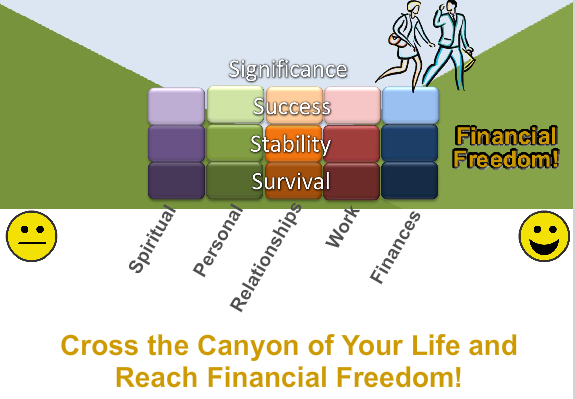 One of the key concepts that iMoneyCoach teaches is that of Life’s Canyon. “What is Life’s Canyon?” you ask. Picture it as a great divide where on one side you are either unhappy or apathetic, basically surviving but not really enjoying life. It’s also a place where your finances are either unsuccessful or mediocre. A place where money is in control rather than you. The other side of the canyon is both happiness and financial freedom. It’s a place where you can get up in the morning and both honestly and enthusiastically say, “I love my life!”
What is financial freedom? It’s freedom from debt. It is freedom in having the money you need to achieve the big dreams you have for your life (i.e. funding your kids’ college, living comfortably in retirement, going on that vacation, starting a charity, etc.). It’s a place where you are in control, a place where your life is in balance so you can be happy and successful.
Sounds great right? I will tell you that it IS possible to get to that place. We’ve helped thousands of people get there, and it’s still a wonderful, encouraging thing every time we see someone new reach that place. So how do you get there? In the simplest explanation… you have to achieve balance. We’ve found over the years that money is really the smallest part of your finances. It’s your life that’s the biggest part. When you are able to achieve success across all areas of your life, you are able to build a bridge that will take you right across that canyon. When some parts of our lives are successful, but others are a mess, we actually create stumbling blocks for ourselves and have no way to cross that bridge (imagine walking across a bridge that drops off way low and then all of the sudden you have a huge wall in front of you). When we have balance, only then are we able to be successful in our finances and find that we love our lives.
This is just a small taste of the concept of Life’s Canyon and Life Balance. If you’d like to learn more, we have a great variety of resources out there. Please check them out:
- Money is the Smallest Part of Your Finances – this book, available as an ebook and in print, explains more about the concept of balance and gives many true life accounts of people who have found success with iMoneyCoach.
- If you struggle with debt or if you make decent money but have nothing to show for it, we have several online courses available to you at the iMoneyCoach University. The Financial Life Training System is the basis for all of the courses, and I recommend starting there because it teaches you all of the basic concepts (plus budgeting, tracking, goal-setting, and much more). Then move on to other courses in areas where you are lacking. They are based upon the 5 main life segments: Personal, Spiritual, Relationships, Work, and Finances.
- Let us know if you would like more information or if you want to meet with one of our Financial Life Coaches. Our goal, quite honestly, is to reclaim America’s financial freedom. We realize it is a lofty goal, but we believe that people do not have to live these unfulfilling and debt-ridden lives. We can all do better with our money! Email us or call the office at 303-462-2001 for more information. You can also visit our home page to learn more.
Tags: finances, financial freedom, life canyon, love my life, money, success
“Worrying is like a rocking chair, it gives you something to do, but it gets you nowhere.” ~ Glenn Turner
The same can be said about being problem focused rather than solution focused. At iMoneyCoach, we have a Financial Constitution, sort of a list of the basic principles that we live by and encourage others to live by as well. One of those principles is to be solution focused rather than problem focused.
It sounds nice and all, but what does it mean? Let me give you an example from a case study on management in Japan:
One of Japan’s largest cosmetic companies received a complaint that a customer had bought a box of soap that turned out to be empty. The authorities immediately isolated the problem to the assembly line where all of the packaged boxes of soap were prepared for delivery – for some reason a box had made it through the line empty. So management asked its engineers to solve the problem.
The engineers came up with an intensive plan, whereby they devised an X-ray machine with high-resolution monitors manned by 2 people. It watched all the soap boxes that passed through the line to make sure they were not empty. This was a big and expensive solution.
Now, an employee in a small company was posed with the same problem. But he came up with a different solution. He simply bought a strong industrial fan, pointed it at the assembly line, and any empty boxes were blown out of the line when they passed. This was a fast, inexpensive solution compared to what the team of engineers came up with.
The point of this story is to remind you to look for simple solutions. The small company employee was not focused on a huge problem he had to solve. Rather, he came up with a simple solution and saved a lot of time and money. When we focus on coming up with a simple solution, we are able to move forward instead of getting stuck staring a problem in the face.
At iMoneyCoach we have placed this goal of being solution focused as opposed to problem focused in the “Personal” category, meaning in your thoughts and emotions. But it can have wonderful results when applied to other areas as well – Think of how your relationships can blossom when you apply it there. Or if you apply it at work, you will end up creating more value for your employer and may be able to see more promotions or raises come through (this would certainly benefit the “Finances” area of your life!). It is a principal you should keep in mind often and try to incorporate as often as possible.
Tags: financial constitution, focus, personal, problem, solution
![[Valid RSS]](images/valid-rss-rogers.png "Validate my RSS feed")