So you may read this blog and some other here and there and wish there was a way you could open up one page and see updated blogs right away instead of having to go to each site to check for updates? Well, there IS a way!
There are several programs out there called RSS Readers. They pull all the latest posts and updates into one page so you don’t have to guess or keep a schedule to look for information. Now you can get the info you want when you want it. Google Reader is an easy one to use, especially if you happen to have Google set as your homepage with a customized setup to see the weather, news headlines, and more each time you open your browser (let me know if you want to set your homepage up this way, it’s easy and so convenient!) Here’s a great video that explains Google Reader in plain English.
Google Reader in Plain English
To stay up-to-date on all the latest from iMoneyCoach, be sure to post http://www.imoneycoach.com/blog/feed into your reader. When we have posted a new article, you’ll get a summary that you can click on for the full article – you are getting the “feed” from our blog to let you know what’s new. We want to keep in touch and get great information out to you to help you make the most of your finances and love your life!

Tags: blog, feed, Google Reader, RSS Reader
 I’ve talked with several people lately about the idea of buying a house for your college student and why that may be a great idea. I think the information is worth sharing and may be useful to many of you out there. Even if you don’t have a college student, the information here could help you select a great rental home to generate some extra income each month.
One of the great things about buying a house in a college town is that demand stays consistent. This is beneficial for a couple different reasons. For one, in the current real estate market, many sellers are facing severe hardships due to falling prices and increased lengths of time their houses are on the market. In a college town, there are constantly people moving to the neighborhood, keeping demand consistent. It may even increase as nowadays more families are emphasizing the importance of higher education, more students are attending college, and enrollments are expected to increase. So even when your student graduates, you can be confident that there will be demand so you can sell the house or rent it.
If you read my blog regularly, or even occasionally, I am sure you will pick up on the fact that we encourage people to find alternative sources of income. Rental properties can be a great way to put some extra money in the bank each month. After your student graduates, you can consider renting out the home. Some things to consider when leasing: professional and adult college students tend to party less and would be more likely to take good care of the home. College towns have also become popular places to retire as well, so you may be able to rent to a baby boomer.
If you would like more information on the benefits of buying a home for your college student, or even buying a rental property in general, be sure to let us know!
Tags: benefits, buying a house, college, extra income, rental home
 Saving money is important to so many people. But so is having an updated and stylish home. The good news is that those two desires do not have to compete. Below I will walk you through the steps for making a custom do-it-yourself homemade headboard that will look great and keep cash in your wallet. By taking a little time to buy the materials and build a headboard yourself, you can save up to several hun
You will need the following materials to build your homemade headboard (not necessarily in this order – read the steps below to see how much you will need and when as well as great tips for saving money when buying the materials):
- Plywood
- Staple gun
- Staples
- Batting
- Fabric
- Buttons
- Heavy thread or yarn
- Long needle or wire
- Iron
- Foam Cushion
- Glue or Mod Podge
- Pen
- Measuring Tape
- Picture hanging kit
- Drill
You will want to have all of your supplies bought when you actually build the headboard, but that doesn’t mean you have to buy them all at once. Since you will be heading to different stores that have different sales and markdowns, you may find that it’s better to plan this project over a month and get all the supplies at a lower price. It’s worth the wait!
Follow these steps to gather the supplies you will need to craft your own homemade headboard:
1. Measure on your wall how big you want your headboard to be. I thought I knew about what I would like mine to be, but then I taped up some yarn to the dimensions, and found that I didn’t like the size! I was so glad I changed the dimensions before I started. Go ahead and tape up an outline and see if you like it – if not, you can always make it taller or shorter or wider or thinner.
2. Get your plywood. You only need a 1/2″ thick piece. You should also be able to get it cut at your local hardware store if you bring your dimensions with you. This may also make the difference between having to tie the wood to the top of your car and being able to fit it in the back. Watch for deals in your local newspaper or online. You may be able to get a good deal.
3. Next you’ll need to make 1 or more visits to a fabric or craft store. Be sure to check the newspaper for coupons! It’s a great way to save fast. A 40% off coupon is a great way to save big bucks, especially if you clip that coupon and use it for each of the supplies you need.
I bought the batting and foam padding first. Both were on sale for 30% off, and I had a coupon, which cut down the cost even more. The foam padding could end up being the most expensive item on the supply list. I used 2″ foam. You can use whatever thickness you desire. 1/2″ will still look great. It just won’t be as cushiony if you like to sit up in bed and read at night. Make sure you get enough foam to cover the whole front of the board.
Now, here’s a great tip for your money-saving experience. Head to the back of the store, past all the racks of the brand new fabrics. Go to the clearance section. Yes, the clearance section – here’s where you may be able to find an awesome deal. My husband and I went shopping together (had to be sure he’d like the new style), and we ended up pulling the top clearance fabric back to see what was underneath. And there we found it! Our fabric was thick, almost canvas-like, and it had just the style and colors we were looking for. And it was only $6.99 a yard!!! This was a great deal considering the fabric we had been previously looking at, even the sale fabric! We bought 2 yards to cover the length of the headboard since the fabric roll was big enough to cover the height. Be sure you get enough fabric to cover the front of the headboard plus the width of the foam and plywood on each side plus about 6 inches on the back (that’s roughly 8-12 inches extra along each edge). The batting should also be big enough to wrap it around to the back of the board.
You can also find your Mod Podge or glue, buttons, and thread or heavy yarn and a needle (I used thick wire we already had at home to save money, but a big needle would work great if you can find a good deal) at the fabric store or craft store as well. I found my buttons 50% off the same day I went in to get my on-sale batting and foam padding. Talk about a great day!
4. If you don’t have any of the other supplies, like the staple gun or drill, as around to see if family, friends, or neighbors have one you can borrow. Be sure to return the item quickly and in great condition, and don’t forget to say “thank you!”
Now you are ready to follow these steps to build your DIY Headboard:
1. The first thing you will want to do is prepare the wood for your headboard. Hopefully you were able to get it cut at the hardware store. If not, use a saw to cut it to size. Then you will want to make small holes (roughly 1/4″ to 1/2″ in diameter) in the back so you will be able to sew in the buttons at the end. An easy way to mark holes for 5 buttons (an odd number is always good for design) is to make a big X on the back of the wood from corner to corner. Drill one hole in the middle where the two lines cross. Then measure halfway between the center and the outside corner along the lines to make the 4 remaining holes. This way they are all equally spaced and end up in the right place. Drill your holes and head to the next step…
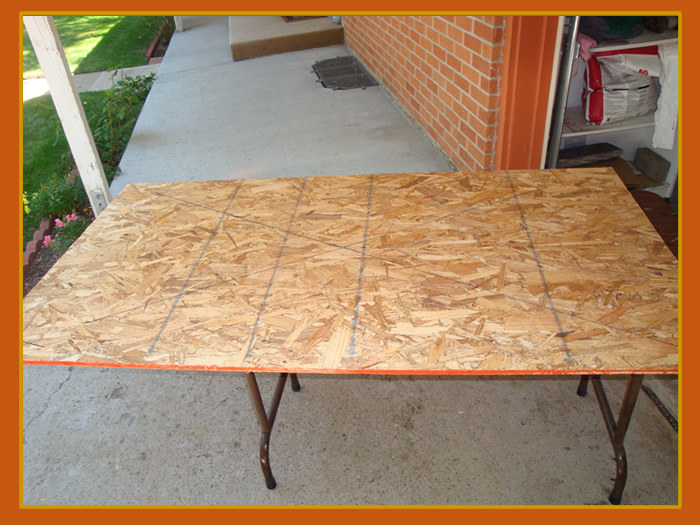
Draw an X from corner to corner
2. Next you will want to head inside and iron your fabric. Even if it “doesn’t look that bad” it’s still worth it to iron your fabric now so it will look nice and smooth at the end of the project. This will also prevent the fabric from stretching out and becoming loose around the board.
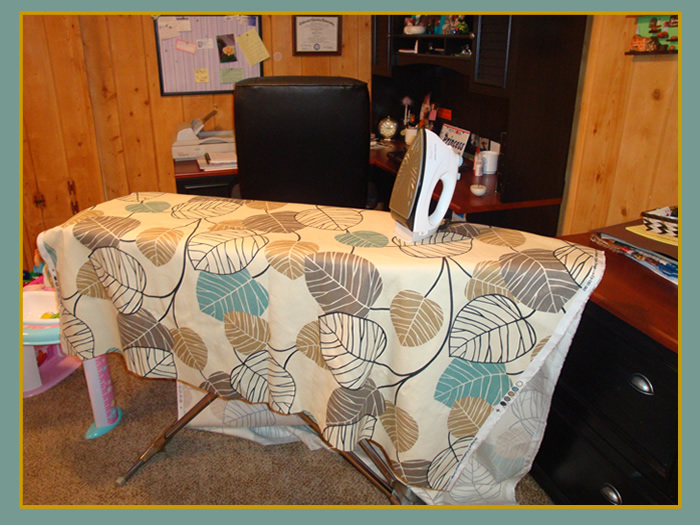
Iron your fabric first to make sure it is wrinkle-free.
3. Next you will attach the foam cushion to your board. I bought 3 strips of the foam padding because it was less expensive – even if I had bought one long strip, there would still be cutting and piecing together to do. Cut your foam so that you can put it together to cover the entire board. A note here: I had to cut about 4″ off one of the tall sides of the foam. I placed the cut side on the outside edge of the board so the manufactured straight edges would form a more even line on the inside. I’d like to think I can cut a pretty nice straight line, but this just made a cleaner union and made it look like one piece.
You can sprinkle Mod Podge or heavy glue or even spray glue across your board. Spray glue tends to be more costly for the same purpose. You are just trying to make sure the foam stays in place, so you don’t need a real heavy duty option.
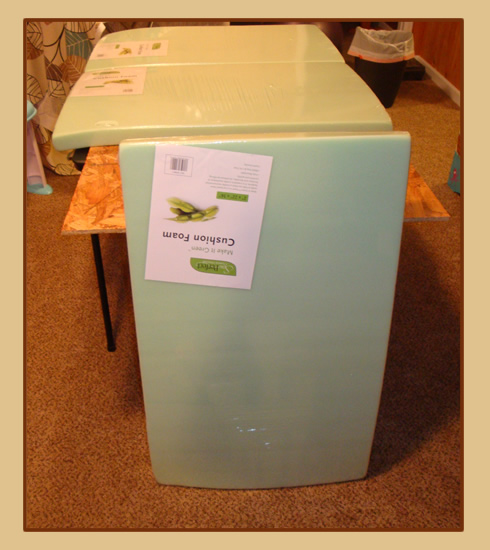
Packaged foam padding
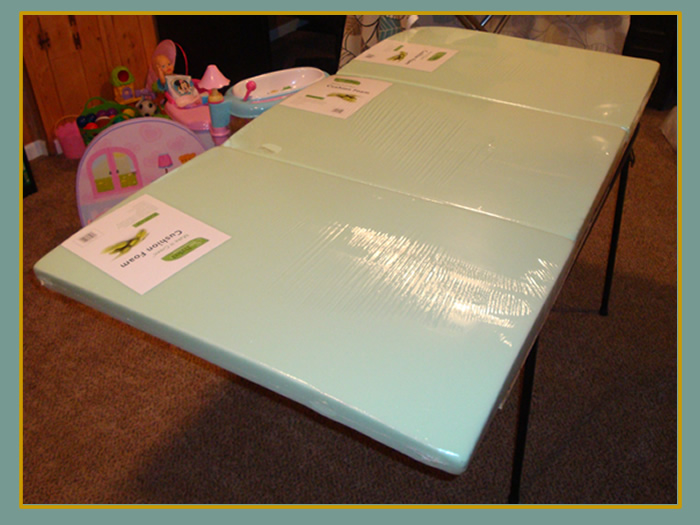
Foam padding laid out on the board
Let the glue dry briefly and head to the next step.
4. You are ready to attach the batting now. If you have not already cut it to size (see dimensions in the beginning of this blog), do so now. You can either keep the board on a table and staple the batting in from below, or lay the batting on the floor and lay the board cushion-side-down on top of it. Staple the batting about every 6 inches all the way around the board, about 1 inch in from the edge.
5. Next you can do the same thing with the fabric for your headboard. Lay it on the floor and put the board on top with the back facing up. You can staple the fabric a little farther in on the board, around 3-4″ in from the edge.
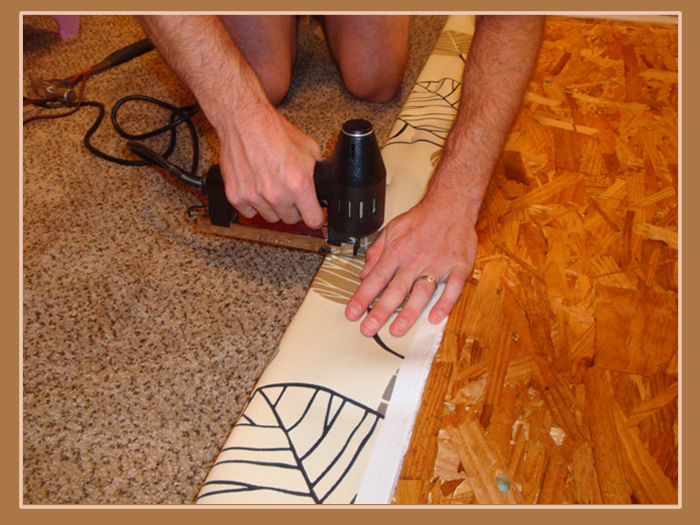
Staple the fabric to your board.
The corners can be intimidating at first. Try folding them like you would the edges of a Christmas present. Your style doesn’t matter so much as making sure you fold each corner the same as the last so they match. Then staple the folds onto the board so they lay flat.
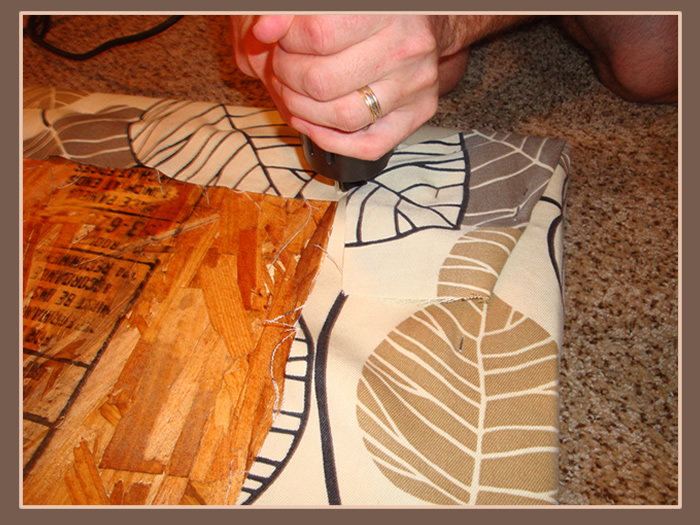
Staple the corners of the fabric to the board
Here’s what your board will look like at this point:
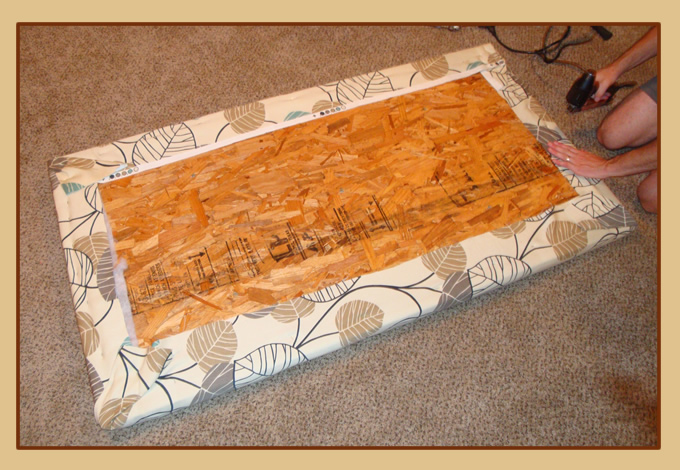
Back of the homemade headboard
6. Now you are ready for buttons. This is a completely optional step. You may decide you like your headboard as is. For others, this little bit of accessorizing really finishes it off. Thread your long needle or heavy wire. Then measure in from the edge where your hole is so you can insert the needle straight through to the place you will need to be to run the needle back through the hole you made in the back. When you’ve pulled the thread or yarn through to the front, run it through your button and push it back through to the back. You can decide how tight you want the button. For a more dramatic look, make it a little tighter. Then staple the yarn or thread to the back of the board to keep it in place.
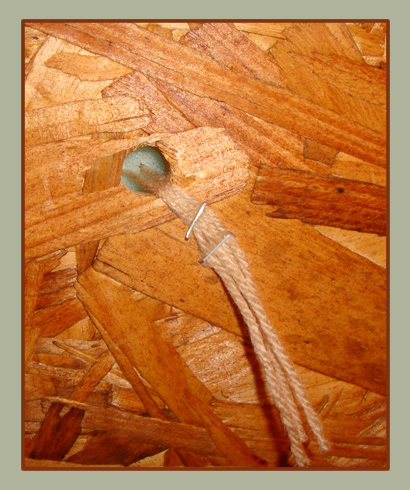
Staple yarn to the back of the board
Here is what your board will look like if you followed the steps above for adding 5 buttons:
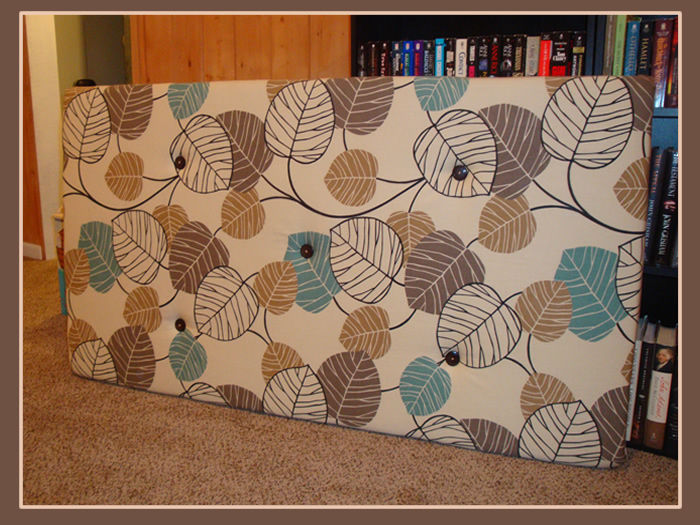
Buttons on the front of the headboard
7. Good work! Now for the finishing touches. You will need to measure down about 8 inches from the top of the board and inside about 8 inches from the sides. Screw on the picture hanger edges that will hold wire across the back of the board. You will be nailing the actual hook into the wall shortly. You will want to pull the wire as tight as you can so that it does not show above the headboard when you hang it. Make sure the wire is securely fastened to both sides of the board. Usually the picture hanging kit has a picture with instructions on how to tie the best knot to keep it secure.
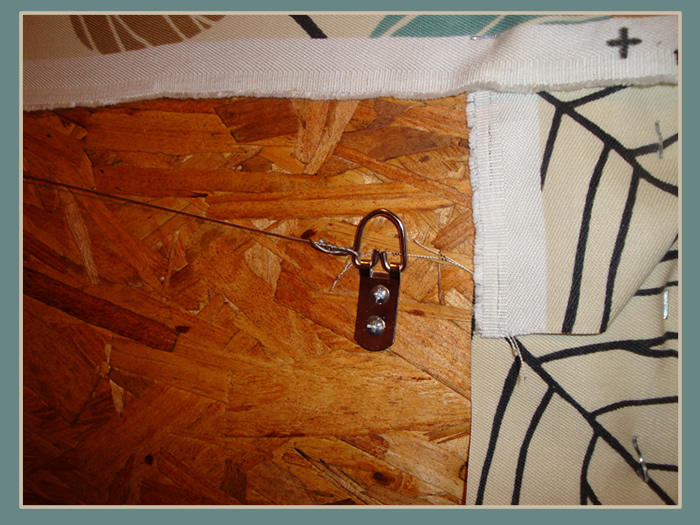
Secure the picture hanging wire to the back of the headboard
8. Now you just need to measure on your wall where to hang the picture hanging hooks. Hang them about 2″ below where the top of the headboard will be – this depends on how tight or loose the wire is, but you can measure on the back of the board with the hooks. I placed each of mine 1/3″ of the way across the board from the outside so they were holding equal weight and would hang straight.
Congratulations! You have just improved the style of your room and saved money in the process! Pat yourself on the back for a job well-done and enjoy a good nap below your beautiful new homemade headboard.
Luxurious homemade headboard at a fraction of the cost
For more money-saving tips and ideas be sure to sign up for the iMoneyMinute emails! We promise never to abuse, sell, or give away any of your information. The iMoneyMinute is an email that we send out once or twice a month that in 1 minute or less will share with you great ways to save money, make money, save time, or reduce your financial risk.
Tags: coupons, DIY, DIY homemade headboard, homemade headboard, save money, saving money
Most people don’t like to think about death or traumatic events, but they do happen, and we do need to be prepared. If something were to happen to you today (we certainly hope nothing does, but we do need to start here), would your family know your wishes? Would they know what your finances were and how to handle them? Do they know where to find last year’s tax return or where your checkbook is?
There are some simple basics that you can do to make preparations for your family regarding your finances. One easy step is to prepare a one-page crib sheet. This would be important to your family, and if there was ever a natural disaster, and you had to flee your home, this sheet would help you reconstruct financial records. You can start by listing what accounts you have and where they are (i.e. checking account at Bank of Money, life insurance account through ABC Life). Leave instructions on this form as to where to find your important personal documents such as your life insurance policies, bank statements, marriage license, birth certificates, and the original copy of your will (important note – you need the original copy, the one that is signed and witnessed. Photocopies are not accepted – if one cannot be found, the law will assume you destroyed it because you no longer agreed with what it originally said. Watch for an upcoming blog regarding wills!). You should also point towards the forms you have showing who your beneficiaries are on your accounts because these determine who gets the funds, not your will.
Once you have created your crib sheet, you should make 2 more copies. Keep one for yourself, but be sure to tell your spouse where it is (or make sure your spouse is involved in the whole process of creating and storing it!). Then give one to someone you trust such as your sibling, a grown child, best friend, or lawyer. Then mail the third copy (you can instruct them to keep it sealed) to someone you trust who lives in another town (this is in case of natural disasters – so if you are in a hurricane, flood, or earthquake, this person is unlikely to have gone through the same disaster and will have your crib sheet intact).
That is the quickest, easiest way to prepare for death or trauma. It will help your family immensely and alleviate much stress in an already stressful and sad time. However, there can still be problems and complications or reasons your family cannot get to the funds you have left them (i.e. they have no idea you have an old retirement account from a company you worked at 30 years ago). There are reasons a lawyer can throw out your will – say you worked up a “do-it-yourself” will and didn’t realize that they can be disregarded in court. A very good way to show your family you love them and want to make sure they are prepared is by completing a more detailed workbook with all of your financial information. We have created just such a workbook, The Bucket Book. While it can seem a daunting task at first, once you walk through the steps, you will be glad you did. Imagine the peace that comes with knowing you have completely organized your finances – if not for your family, then for yourself so you know what you have and where it is located. We encourage you to take some steps towards financial organization and preparation. Again, we understand that it is not something people normally like to think about, but it is something that does happen. And you can take action to make sure that you and your family are prepared!
 With the recent economic times, I’ve come across a surprising number of people considering using their 401(k) funds to pay down debt. I don’t want to leave you with a simple “no, you shouldn’t do that” and skip a good discussion on why or what your options may be. So here goes…
If you are under age 59 ½ and withdraw money from your 401(k) you will face high fees. You will lose 35-45% of the withdrawal to taxes and penalties. Of course that is a high percentage and may give you pause, but you might think it’s worth it. You need to consider whether the fees you are charged to take out that money will be more or less than the interest you are paying on your debt. It is very likely that the interest you will pay on your debt is not enough to counterbalance those high fees. Translation = you would lose money by paying down debt with your 401(k) funds.
So what can you do? You may consider reducing the amount of money you are currently contributing to your 401(k) and putting that amount towards your debt. Then once the debt is paid off, be sure to start putting those funds towards your 401(k) again. If you can, though, make sure you are at least contributing up to the amount your employer will match, if they match contributions. You don’t want to leave free money on the table. But that’s a topic for another day.
Occasionally using your 401(k) funds may be beneficial. For example, you may be able to take a loan on your 401(k) to purchase a rental property that will bring in more income. I’ve often mentioned the benefits of generating alternative income, and in some cases (like the rental property purchase), it may be wise to use 401(k) funds. It is important to know the rules for 401(k) withdrawals or loans though, so make sure you do some research or talk to a financial advisor first.
If you are looking for a PROVEN debt elimination system be sure to check out the iMoneyCoach Debtinator! (http://store.imoneycoach.com/Debt_Elimination_Work_Book_p/debt%20elimination%20work%20book.htm) We’ve worked with hundreds of people using this system to help them get out of debt and stay out of debt. That last part is something most debt-elimination systems do not provide, which is why people end up back in debt, often worse than before.
Tags: 401(k), debt, debt elimination, matching
![[Valid RSS]](images/valid-rss-rogers.png "Validate my RSS feed")